A statement necklace can transform a plain turtleneck into a deliberate, polished outfit. Yet the wrong scale may create visual crowding around the face. This guide explores How to style a statement necklace with a turtleneck through seven practical, wearable approaches.
The styling principle is simple: control proportion, texture, and placement. A sleek black turtleneck can support a bright pendant, layered chains, or sculptural metal links. A chunky knit usually needs a shorter, stronger necklace that remains visible above the fabric. Check the neckline first. Then consider the necklace’s weight, color, and movement. Small details matter, such as whether a pendant catches beneath a coat collar or disappears into a soft ribbed knit.
Fashion designer Michael Kors once said, “I’ve always thought of accessories as the exclamation point of a woman’s outfit.” His observation applies well here, although a statement necklace should not overpower every other detail. Let the necklace lead, then keep earrings, prints, and handbags quieter. That balance often looks more modern than adding several competing accents.
There is no single perfect formula. Some combinations will feel excessive. That is useful feedback, not failure. Try the necklace in natural light, take a quick photograph, and inspect the space around your face. A mirror can be forgiving. A camera is less so. The following ideas cover refined, casual, minimalist, and evening styling options, while leaving room for personal taste and a little experimentation.
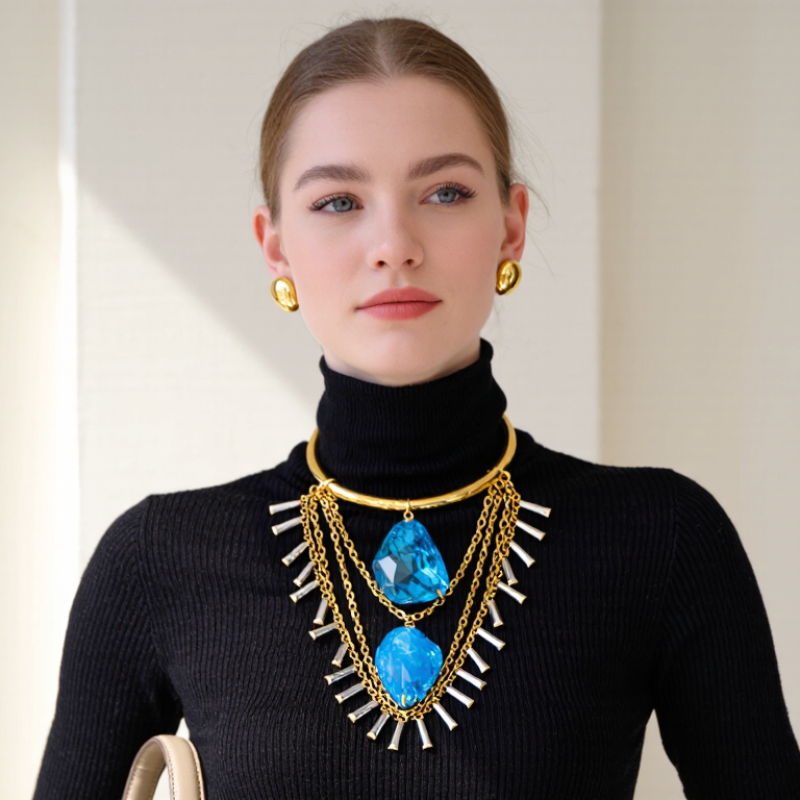
Choosing the Right Statement Necklace for Your Turtleneck
Choosing the Right Statement Necklace for Your Turtleneck
A turtleneck creates a clean, uninterrupted background for bold jewelry. Choose a necklace that contrasts with its fabric and neckline. Chunky chains work well with smooth, fine-knit turtlenecks. Sculptural pendants suit thicker sweaters with simple textures. I usually match the necklace’s visual weight to the sweater’s volume. A loose, heavy knit can make a delicate pendant disappear.
Consider length carefully. A collar-length necklace emphasizes the face and works best with a slim turtleneck. A longer pendant creates a vertical line, which can balance a high, bulky collar. Choose rounded shapes for softer outfits, or geometric designs for sharper tailoring. Warm metal tones can brighten cream, camel, or rust. Cool finishes often look crisp against charcoal, navy, or white. Still, these rules are not absolute. I once paired a large pendant with a thick sweater, and the result felt crowded.
Tips: Test the necklace in natural light. Check whether it catches on the knit. Keep earrings quieter when the necklace is dramatic. Leave a small visual gap when possible. Less can work. A simple necklace may look stronger than an oversized one if the turtleneck already has cables, ribs, or decorative seams. Stand sideways before deciding, because the pendant may shift awkwardly across the fabric.
7 Best Ways to Style a Statement Necklace with a Turtleneck? - Choosing the Right Statement Necklace for Your Turtleneck
| No. |
Styling Method |
Recommended Necklace Shape |
Ideal Necklace Length |
Best Turtleneck Type |
Visual Effect |
Practical Styling Tip |
| 1 |
Use a Bold Pendant |
Large geometric pendant or sculptural centerpiece |
20–24 in (51–61 cm) |
Fine-knit, close-fitting turtleneck |
Creates one clear focal point in the center of the outfit |
Keep the rest of the outfit streamlined so the pendant remains the main feature. |
| 2 |
Layer Multiple Chains |
Two or three chains with different textures and pendant sizes |
18–30 in (46–76 cm) |
Smooth, lightweight turtleneck |
Adds depth and movement without relying on a printed pattern |
Vary chain lengths by at least 2–3 in (5–8 cm) to reduce tangling and improve separation. |
| 3 |
Choose a Collar-Length Piece |
Short bib, collar, or bib-style statement necklace |
14–18 in (36–46 cm) |
High, neatly folded turtleneck |
Frames the face and emphasizes the neckline |
Place the necklace over the fabric rather than under the collar for a sharper outline. |
| 4 |
Match a Long Pendant to a Slim Silhouette |
Vertical pendant, lariat, or elongated geometric design |
24–36 in (61–91 cm) |
Thin or medium-weight fitted turtleneck |
Creates a lengthening vertical line |
Wear it centered and avoid placing it directly over bulky ribbing that may distort the line. |
| 5 |
Contrast the Necklace with the Knit |
Smooth metal, polished beads, or glossy stones |
18–26 in (46–66 cm) |
Chunky, cable-knit, or textured turtleneck |
Balances tactile texture with a clean reflective surface |
Choose a necklace with a smooth back or rounded edges to reduce snagging on the knit. |
| 6 |
Coordinate Color with the Turtleneck |
A contrasting metal or a complementary colored pendant |
16–24 in (41–61 cm) |
Solid-color turtleneck |
Improves contrast and makes the necklace easier to notice |
Use one dominant color relationship instead of combining several competing accent colors. |
| 7 |
Balance Proportions for the Occasion |
Medium-to-large pendant, chain, or bead design |
18–30 in (46–76 cm) |
Any turtleneck, selected according to fabric weight |
Adjusts the outfit from polished daytime wear to evening statement dressing |
Choose lighter designs for work and heavier, more dramatic pieces for evening or special occasions. |
Quick selection guide: Fine-knit turtlenecks can support detailed or layered necklaces, while chunky turtlenecks usually look more balanced with smooth, larger-scale pieces. Necklace length is measured from the clasp to the lowest point of the design.
Balancing Necklace Size, Shape, and Turtleneck Thickness
7 Best Ways to Style a Statement Necklace with a Turtleneck
A turtleneck creates a clean, high neckline, so necklace scale matters immediately.
McKinsey and The Business of Fashion project fine-jewellery sales will grow 1–3% annually through 2028.
That suggests shoppers may value fewer, more intentional pieces. A bold necklace can provide that focus, but size should follow fabric weight. Pair a chunky knit with a broad pendant or layered metal links. Choose a slimmer collar with a flatter, medium-sized design.
Shape changes the visual balance. Long pendants create a vertical line and can make a thick turtleneck feel less crowded. Short, rounded pieces echo the neckline and look polished with lightweight jersey. Geometric shapes add structure to soft wool. Curved forms feel gentler against ribbed textures.
The Global Jewelry Market report from Grand View Research estimates strong growth in fashion jewellery through 2030, reflecting continued interest in expressive accessories.
Texture matters too. Keep glossy metal against matte fabric for contrast. Try one dominant necklace, then add only a delicate chain if the outfit feels empty. Avoid placing a heavy pendant exactly where the fabric bunches. It may twist, annoy the neck, and photograph poorly.
I used to match necklace size only to body scale. That was too simple.
Turtleneck thickness, shoulder width, and pendant movement also matter. The best test is practical: turn your head, sit down, and check whether the necklace still feels balanced.
Feel comes first.
Layering Necklaces Without Overcrowding the High Neckline
7 Best Ways to Style a Statement Necklace with a Turtleneck
A turtleneck creates a tall, uninterrupted neckline, so necklace layering needs restraint. Start with one statement piece that sits above the fabric, not across your throat. A short pendant, sculptural collar, or bold chain can frame your face without competing with the knit. For a softer effect, add a fine necklace beneath it and keep both lengths clearly separated. Three visible layers often feel crowded.
Try different textures. Pair a smooth metal necklace with a ribbed turtleneck, or place a matte pendant over a silky knit. A long chain can create a vertical line and make the outfit feel lighter. You can also wear two delicate necklaces at uneven lengths, using small charms rather than several large stones. For balance, match the necklace’s visual weight with simple earrings and a clean hairstyle. Heavy earrings may overwhelm the same area.
Tips: Leave about two inches between necklace layers. Check the look in side lighting, where overlapping chains become easier to spot. Keep one focal point. If the neckline is thick, choose a longer pendant. If the fabric is thin, a close-fitting collar necklace usually works better. I sometimes remove one layer after taking a photo; mirrors can hide visual clutter. A slightly imperfect mix can feel personal, but tangled chains rarely look intentional. Test the outfit while moving, since necklaces may shift when you turn your head.
7 Best Ways to Style a Statement Necklace with a Turtleneck
Necklace length affects how clearly a statement piece stands out against a high neckline. These representative lengths reflect common necklace-size categories and can help create balanced layered looks without overcrowding the turtleneck.
Shorter styles frame the neck, while longer pendants create separation from the turtleneck. For layered outfits, combine different lengths and keep one necklace as the visual focal point.
Matching Metals, Colors, and Textures to Your Outfit
A statement necklace can sharpen a soft turtleneck, but proportion matters. Choose a shorter pendant over a thin knit, or a longer chain over a bulky collar. Seven styling routes work well: layered chains, one sculptural pendant, a collar necklace, mixed metal strands, colored beads, textured links, or a brooch-style centerpiece. Silver suits cool gray and icy blue. Gold warms camel, cream, and chocolate. Black metal creates stronger contrast with pale knitwear.
Texture prevents the outfit from looking flat. Pair a smooth metal necklace with ribbed wool, or use hammered metal against a sleek cashmere surface. The 2024 McKinsey and The Business of Fashion State of Fashion report emphasizes value-conscious purchasing and stronger wardrobe versatility. One adaptable necklace can therefore support several outfits, rather than one dramatic occasion. Jewelry industry reports from Grand View Research also project continued growth in fashion jewelry, driven by self-expression and accessible styling. The numbers support experimentation, though forecasts are not guarantees.
Tips: Keep one focal point. If the necklace is wide, choose small earrings. Match warm metals with warm colors, but do not treat this as a strict rule. I sometimes mix silver and gold, and the result looks better with a neutral turtleneck. Check the neckline in daylight. A necklace may appear balanced indoors but too heavy outside. Leave a little breathing room above the pendant; crowded layers can make the neck look shorter. A small mistake can be useful. Try reversing the order of metals before removing one.
Finishing the Look with Coordinated Clothing and Accessories
A statement necklace can make a turtleneck feel polished, but the surrounding pieces control its impact. The State of Fashion 2024, published by McKinsey & Company and The Business of Fashion, projected global fashion growth of only 2% to 4%. Versatile styling matters in a cautious market.
Start with a tonal necklace and turtleneck for a long, elegant line. Add a structured blazer in a nearby shade. Choose a slim belt to repeat the necklace’s metal finish. Keep it intentional.
For contrast, pair a dark turtleneck with a bright necklace and tailored trousers. Echo one necklace color in your handbag or shoes. A textured knit works well with smooth metal, while a sleek knit suits sculptural stones. Layer a long coat over the outfit when the necklace needs more visual space. Keep earrings small, especially with a wide pendant.
Statista Market Insights estimated 2024 global apparel revenue at roughly US$1.7 trillion, reminding us that accessories can refresh existing clothing without rebuilding an entire wardrobe. I sometimes over-coordinate jewelry, and the result looks too planned. A slightly different texture can feel more personal. Still, mismatched colors may look accidental. Check the outfit in natural light, then remove one piece if the neckline feels crowded.
Conclusion
Discover How to style a statement necklace with a turtleneck by focusing on proportion, balance, and coordination. Choose a necklace that complements the thickness and shape of your turtleneck rather than competing with it. A bold pendant can create a clear focal point, while shorter designs may work best with a slimmer, close-fitting neckline. Consider the necklace’s size, structure, and length so it sits comfortably and remains visible without making the upper body look crowded.
For a layered effect, combine necklaces with different lengths and simple shapes, leaving enough space between each piece. Match metals, colors, and textures to your clothing for a polished appearance, or use thoughtful contrast to add personality. Complete the outfit with coordinated earrings, bracelets, belts, bags, or shoes, keeping the overall styling balanced. Whether your look is refined, casual, or artistic, the right statement necklace can turn a basic turtleneck into a confident and well-planned outfit.

